
No products in the cart.
Music T Shirts
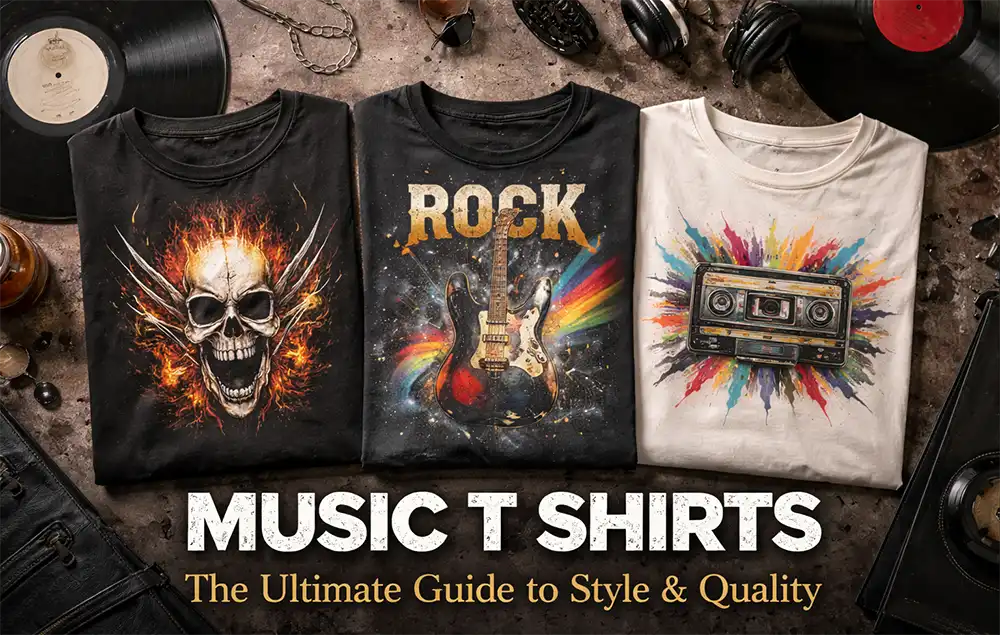
The Ultimate Guide to Music T Shirts: Culture, Craft & Timeless Style
22
Feb
Feb
Cultural Foundation and Historical Evolution of Music T Shirts
Music has always shaped identity long before fashion tried to interpret it. Long before social media turned taste into algorithmic display, music already functioned as a personal declaration. What you listened to said something about how you thought, how you felt, and where you belonged.
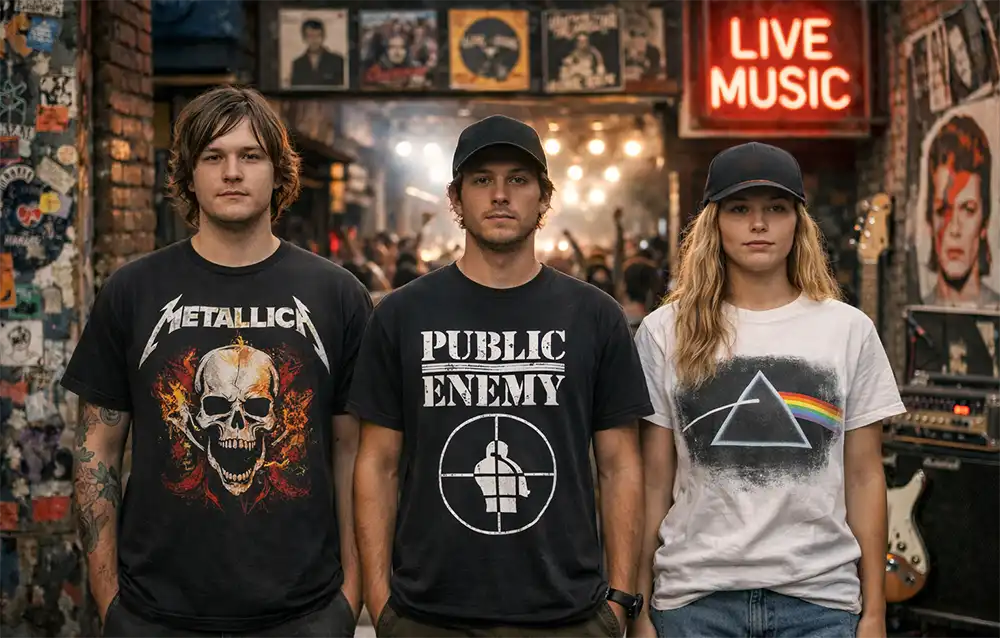
Music t shirts emerged from that ecosystem of identity.
They were never just garments. They were artifacts.
In their earliest form, music t shirts were simple merchandise items sold outside venues. A band toured, fans gathered, and cotton tees printed with logos and tour dates were offered as memorabilia. At that stage, the shirt functioned as proof of attendance — a physical receipt of experience.
But unlike ticket stubs or folded posters, the shirt entered daily life.
That transition changed everything.
Once these garments moved beyond the concert venue, music t shirts evolved into something far more powerful than merchandise. They became quiet declarations. Even in silence, they spoke. A person walking down the street in a distressed tee from a rock band shirts collection projects a very different energy than someone choosing the nostalgic softness of vintage band tees. Meanwhile, contemporary interpretations found in expressive music graphic tees suggest a shift toward design-forward storytelling rather than pure fandom.
In each case, the garment operates as a medium — a visible alignment of taste, memory, and cultural position. Once clothing begins communicating identity at that level, it stops being casual apparel and starts becoming part of a personal narrative.
And once clothing becomes a medium of identity, it stops being disposable.
The 1970s – Raw Expression and Subculture
The 1970s marked the first true cultural explosion of band shirts. Rock culture was rebellious, loud, and anti-establishment. The shirts mirrored that energy.
Graphics were bold. Typography was aggressive. Cotton was thick and unrefined. These were not polished fashion pieces — they were extensions of stage intensity.
The important detail is this: the shirts were not designed to be “stylish.” They were designed to represent allegiance.
Subculture was the driving force.
Punk, hard rock, and underground scenes used clothing as tribal markers. Music t shirts acted as identifiers in public space. You could spot your community without speaking.
That function made them socially powerful.
The 1980s – Amplification and Iconography
By the 1980s, music had become more theatrical. Stadium tours expanded scale. Album art grew elaborate. Merch followed suit.
Back prints featuring tour dates became common. Graphics covered more surface area. The shirt evolved into wearable poster art.
This decade cemented the idea that a band shirt was more than branding — it was visual storytelling. Iconic album covers became embedded in fashion memory.
Importantly, this era established music t shirts as collectible objects. Fans began preserving them. Scarcity increased perceived value. Emotional attachment deepened.
The seeds of today’s vintage market were planted here.
The 1990s – Texture, Nostalgia, and the Birth of Vintage
If the 80s were loud, the 90s were introspective.
Silhouettes relaxed. Fabrics softened. Wash treatments became common. Graphics began to fade intentionally. The aesthetic shifted from aggressive to nostalgic.
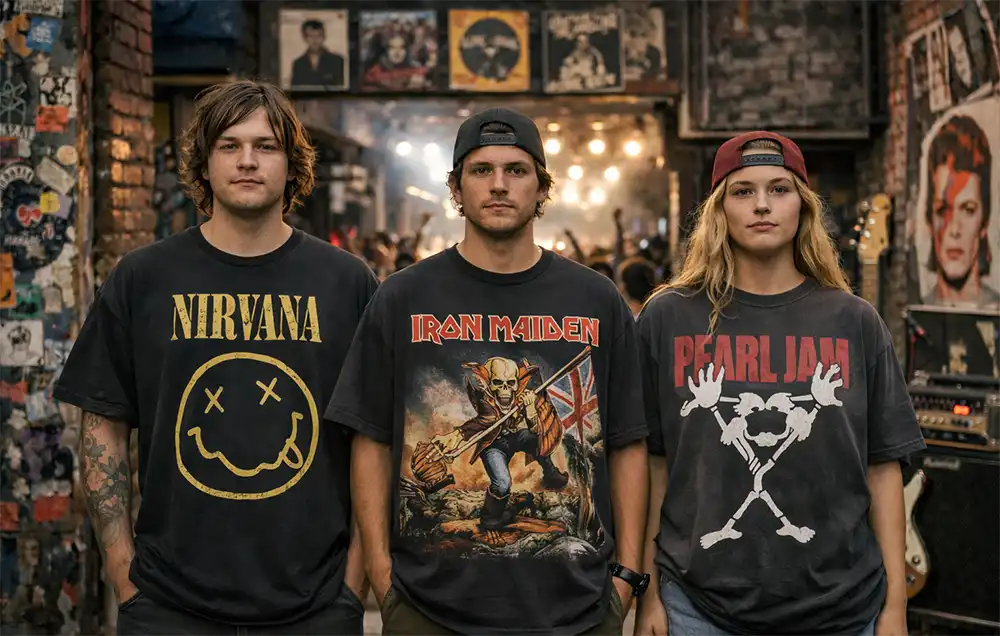
This era birthed what we now label vintage band tees.
The cultural shift here was subtle but significant. Instead of projecting rebellion outward, shirts began projecting memory inward. They felt personal, almost intimate.
The distressed look was not accidental — it implied history. Even newly produced shirts were treated to look aged. Consumers responded strongly to that emotional cue.
For the first time, music t shirts were being worn not only for current fandom, but for era representation.
They became time capsules.
The 2000s – When Fashion Absorbed Music Culture
The early 2000s marked a major shift: fashion recognized the commercial and symbolic power of music t shirts.
Designers incorporated band graphics into runway collections. Streetwear brands leaned heavily into music iconography. Vintage stores curated band tees as premium resale items.
At this stage, music t shirts crossed from subculture into mainstream fashion architecture.
They were no longer confined to concerts or underground scenes. They were layered under blazers, paired with designer sneakers, styled deliberately.
This integration ensured their survival.
Once a garment becomes compatible with multiple fashion ecosystems — casual, streetwear, elevated casual — it gains structural longevity.
The 2010s to 2026 – Identity in the Digital Era
In the age of social media, identity signaling intensified.
Music streaming became private. Headphones isolated listeners. Public audio culture decreased. But visual identity increased.
Clothing became the replacement signal.
Music t shirts filled that gap naturally.
Instead of hearing someone’s playlist, you saw it on their chest.
Meanwhile, digital art expanded graphic experimentation. Typography evolved. Oversized silhouettes dominated. Sustainable cotton conversations entered mainstream fashion discourse.
Through all these changes, music t shirts adapted.
They absorbed streetwear proportions.
They incorporated modern printing techniques.
They embraced minimalist and maximalist cycles.
They survived normcore.
They survived quiet luxury.
Because they are not trend-dependent. They are culture-dependent.
And culture is iterative, not temporary.
Why This History Matters for Today’s Buyer
Understanding this evolution changes how you evaluate music t shirts today.
You are not buying a graphic.
You are participating in a cultural lineage.
When you choose between a bold rock print, a faded vintage-inspired piece, or a minimalist music graphic, you are aligning yourself with a specific historical thread.
That awareness elevates purchasing decisions from impulse to intention.
It also explains why the category remains competitive in search and in fashion: it carries emotional and historical weight.
Music t shirts have survived five decades of aesthetic turnover because they operate at the intersection of sound, memory, and self-expression.
That intersection does not expire.
Construction, Craft, Authenticity, and the Psychology of Value
If cultural depth explains why music t shirts endure, construction explains why some deserve to endure.
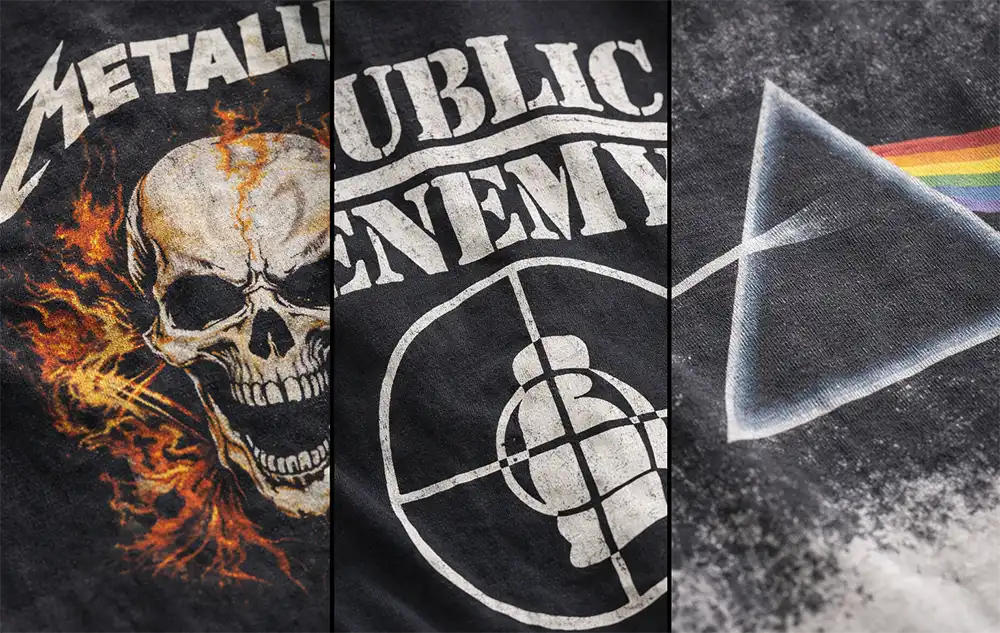
From a distance, most printed tees look similar. A band name, an album graphic, some distressed ink. But quality in music t shirts reveals itself over time — after ten washes, after repeated wear, after the cotton has been tested by friction and gravity.
Understanding construction separates collectors from impulse buyers.
Fabric Weight: Structure Is Identity
Fabric weight is one of the most overlooked yet decisive factors.
Lightweight cotton (often under 4.5 oz) feels soft initially. It drapes easily and works well in hot climates. However, it frequently lacks structural resilience. Over time, lightweight tees can twist along side seams, lose shoulder integrity, and stretch unevenly at the collar.
Midweight to heavyweight cotton (5.3 oz and above) offers a different experience. The garment maintains form. The neckline sits cleanly. The silhouette holds its intended proportions.
For music t shirts specifically, fabric weight influences presence. A bold rock graphic printed on thin cotton often feels visually disconnected from the body. On heavier cotton, the same graphic feels grounded and deliberate.
Weight is not just about durability — it shapes visual authority.
Fiber Quality and Weave Density
Two shirts can share identical fabric weight yet age very differently.
Higher-quality cotton fibers are longer and more uniform. This results in smoother surfaces, tighter weave density, and reduced pilling over time.
Lower-grade cotton tends to pill faster, especially under friction at sleeves and waistline. For music t shirts that rely heavily on printed graphics, surface smoothness directly affects print longevity. Rougher fabric fibers can cause cracking or flaking earlier.
Weave density also impacts shrinkage behavior. Looser weaves are more prone to distortion after repeated washes. Tight construction helps maintain shape.
A shirt that maintains geometry retains credibility.
Print Technique: Ink Is Architecture
Not all prints are equal.
Traditional screen printing embeds ink into fibers in layered passes. The result is depth, vibrancy, and resistance to premature cracking. Well-executed screen prints soften slightly over time without losing clarity.
Heat transfer prints sit more superficially on the surface. They often feel plasticky when new and tend to crack along stress points after repeated wear.
Water-based inks create a softer hand feel and integrate more seamlessly into cotton, particularly effective for vintage-inspired music t shirts.
Plastisol inks produce bold opacity, ideal for high-contrast rock graphics.
The print technique should match the design intention. Aggressive heavy metal artwork may benefit from thicker ink presence. Faded vintage aesthetics require softer integration.
Ink is not decoration — it is structural design.
Garment Dye vs Piece Dye
Garment-dyed shirts are dyed after construction. This process often produces slightly uneven coloration and richer tonal depth, mimicking natural aging.
Piece-dyed shirts are dyed at fabric stage before cutting and sewing. They provide consistent color but often lack the nuanced tonal variation associated with vintage appeal.
For buyers seeking authenticity in aesthetic, garment-dyed music t shirts tend to age more gracefully.
Fit Architecture: Intentional vs Accidental Oversize
Oversized silhouettes dominate contemporary fashion. However, true oversized design differs from simply sizing up.
Intentional oversized tees maintain proportion between shoulder drop, sleeve width, body width, and length. The balance ensures drape feels architectural rather than sloppy.
Accidental oversizing — choosing a larger standard-fit shirt — often results in disproportionate length or awkward sleeve placement.
Music t shirts function as visual anchors. If the fit architecture feels careless, the entire outfit destabilizes.
Fit precision communicates control.
Authentic Vintage vs Modern Reproduction
The vintage market around music t shirts is powerful — and frequently misunderstood.
Authentic vintage shirts (typically pre-2000) carry historical credibility. They may feature single-stitch hems, era-specific tags, and naturally aged cotton. Collectors value these markers.
However, authentic vintage also carries risk: dry rot, weakened fibers, cracking prints, and unpredictable sizing.
Modern reproductions replicate the aesthetic without inheriting fragility. High-quality reproductions can exceed original durability while preserving era-accurate visuals.
For daily wear, reproduction often offers superior practicality.
For collectors, authenticity holds symbolic value beyond durability.
Understanding your intent — daily styling versus archival collecting — determines which path makes sense.
The Economics and Psychology of Pricing
Why does one music t shirt retail for $25 while another approaches $90 or more?
Material cost explains part of the difference. Heavier cotton costs more. Multi-layer screen prints increase production expense. Licensing agreements with artists or estates add legal cost.
Limited production runs amplify scarcity perception.
But psychology amplifies value beyond cost structure.
When a shirt references a culturally iconic band or era, its symbolic weight increases perceived worth. Consumers are not buying cotton and ink alone — they are purchasing narrative proximity.
Scarcity further intensifies this effect. Limited releases create urgency. Urgency increases conversion rates.
However, price alone does not equal quality.
Smart buyers evaluate:
- Fabric integrity
- Print execution
- Licensing legitimacy
- Fit architecture
- Long-term wear potential
A moderately priced, well-constructed music t shirt often outperforms overpriced hype-driven alternatives.
Longevity as Value Metric
In fast fashion environments, clothing is often evaluated by trend lifespan. Music t shirts operate differently.
Their value is measured by emotional durability.
If a shirt remains relevant to your identity after years, it has delivered return on investment beyond raw cost.
Durability extends this value. A well-made shirt that survives dozens of washes while retaining structure compounds its worth.
Longevity transforms purchase into asset.
Why Construction Knowledge Matters for Authority
For a niche to dominate search and trust, depth must exceed surface commentary.
Discussing construction signals expertise. Understanding fabric science, print methodology, and fit architecture differentiates authoritative content from generic fashion blogs.
When readers learn something they did not previously know — something practical and evaluative — trust increases.
Trust increases time on page.
Time on page increases engagement signals.
Engagement strengthens organic ranking.
Construction knowledge is not filler. It is strategic authority building.
Styling Systems, Wardrobe Integration, and the Psychology of Choosing the Right Music T Shirt
If cultural history explains why music t shirts matter, and construction explains which ones deserve attention, styling explains how they function in real life.
A shirt sitting folded in a drawer has no impact. A shirt integrated into a wardrobe system becomes powerful.
The mistake most buyers make is treating music t shirts as isolated graphic pieces. They buy based on impulse — a band they like, an album cover that triggers nostalgia — without considering how the garment will interact with the rest of their closet.
Intentional styling changes that.
Music T Shirts as Wardrobe Anchors
Every wardrobe benefits from anchor pieces — garments that naturally draw attention and stabilize the visual narrative of an outfit.
Music t shirts are uniquely suited for this role because they carry built-in symbolism. A strong graphic provides visual weight. That weight allows surrounding pieces to remain minimal.
For example:
A bold rock graphic paired with structured denim and neutral footwear creates balance. The shirt leads. Everything else supports.
A faded vintage band tee layered under a tailored blazer introduces tension between nostalgia and structure. That contrast generates depth.
A minimalist music graphic tees worn with relaxed trousers and clean sneakers builds contemporary streetwear credibility without appearing forced.
In each scenario, the shirt anchors the look.
The Three Styling Frameworks That Always Work
Rather than memorizing endless outfit combinations, it is more useful to understand frameworks.
1. Contrast Framework
Contrast builds visual interest.
Pairing a rugged rock band shirt with refined tailoring creates high-low balance. The graphic introduces rawness. The structured outer layer introduces polish.
This framework works particularly well for modern urban styling, where cultural and professional identities overlap.
2. Echo Framework
Echoing colors or graphic tones within the outfit creates cohesion.
If a music t shirt features muted vintage reds and creams, selecting footwear or outerwear within that tonal family creates subtle harmony.
The outfit feels intentional rather than assembled.
3. Minimal Support Framework
When the shirt is visually dominant, surrounding pieces should simplify.
Neutral trousers.
Minimal accessories.
Clean silhouettes.
This framework prevents graphic overload.
Oversized vs Structured Fit: Choosing Intentionally
Oversized music t shirts dominate current streetwear aesthetics. However, oversizing must align with body proportions and outfit context.
Intentional oversized styling pairs well with relaxed trousers, cargo pants, or wide-leg denim. The silhouette reads cohesive.
Structured standard-fit shirts integrate better with slim or straight-leg bottoms, creating cleaner lines.
The key is proportional harmony. When top and bottom volumes conflict, the outfit destabilizes.
Fit is architecture, not accident.
Layering as Identity Multiplier
Layering amplifies the impact of music t shirts.
Under denim jackets, flannels, overshirts, or lightweight tailoring, the graphic peeks strategically. This controlled visibility allows the shirt to communicate without overwhelming.
In transitional seasons, layering also extends usability. A strong music t shirt should function across climates — alone in summer, layered in fall.
Versatility increases value.
The Capsule Wardrobe Approach to Music T Shirts
Instead of accumulating dozens of random prints, consider a capsule approach.
One bold statement piece.
One vintage-inspired neutral piece.
One minimalist or typography-driven graphic.
These three categories cover most styling contexts.
From there, expansion can remain intentional rather than impulsive.
Capsule thinking prevents graphic fatigue.
Buyer Psychology: Why We Gravitate Toward Certain Prints
Purchasing decisions are rarely rational.
Music t shirts trigger memory pathways. A band associated with adolescence activates emotional imprinting. A specific album art recalls a moment in time.
This emotional activation increases purchase probability.
However, emotional activation does not guarantee long-term wear.
The intelligent buyer pauses and asks:
Will this shirt still align with my identity in two years?
Can I style this in at least three ways with existing wardrobe pieces?
Does the fit match my current silhouette preference?
These questions introduce discipline into emotional buying.
Avoiding Common Styling and Buying Mistakes
One frequent mistake is graphic redundancy — owning multiple shirts that serve the same visual function.
Another is neglecting fabric weight. Lightweight shirts often fail to anchor layered outfits.
A third is chasing trend-driven graphics disconnected from personal taste. When trends shift, those pieces feel outdated quickly.
Intentional selection reduces regret.
Music T Shirts in Professional and Social Contexts
A common misconception is that music t shirts belong exclusively in casual environments.
In reality, context determines appropriateness.
Under structured outerwear, paired with tailored trousers and clean footwear, a subtle vintage band tee can function in creative professional settings.
At social events, music t shirts often act as conversation catalysts. They provide immediate shared reference points.
Clothing that generates dialogue increases social utility.
Building Personal Uniforms Around Music
Many style-conscious individuals develop personal uniforms — consistent outfit formulas that reduce decision fatigue.
Music t shirts can anchor such uniforms.
For example:
Vintage tee + straight denim + leather sneakers.
Oversized graphic + relaxed trousers + statement boots.
Minimalist music print + cropped jacket + neutral trainers.
Uniform thinking streamlines daily dressing while maintaining expressive depth.
The Long-Term Value Perspective
When integrated correctly, music t shirts transition from novelty purchases to foundational garments.
They age.
They soften.
They develop character.
Unlike fast-fashion graphic trends that expire quickly, culturally grounded music t shirts often gain credibility over time.
A shirt worn repeatedly accumulates story.
That accumulation increases attachment value.
From a cost-per-wear perspective, a high-quality music t shirt worn consistently outperforms cheaper alternatives worn sporadically.
Longevity is both emotional and financial.
From Authority to Action
Understanding styling systems and buyer psychology does not mean overanalyzing every purchase.
It means elevating awareness.
When awareness increases, purchase satisfaction increases.
When purchase satisfaction increases, brand trust increases.
When brand trust increases, long-term loyalty follows.
Music t shirts are not impulse decorations.
They are tools of identity construction.
Treating them as such changes both wardrobe outcomes and purchasing behavior.
2026 Trends, Cultural Direction, Sustainability, and the Future of Music T Shirts
The Oversized Era Is Maturing — Not Disappearing
Oversized silhouettes have dominated streetwear for years. In 2026, that dominance is stabilizing rather than accelerating.
Instead of exaggerated extremes, proportions are becoming more refined. Shoulders remain relaxed, but length is slightly controlled. Sleeves are wider but not overwhelming.
This maturity signals an important shift: buyers are no longer chasing novelty. They are seeking balance.
Music t shirts that respect proportion — rather than blindly following trend extremes — will outlast the current wave.
Structural oversize is here to stay. Sloppy oversize is fading.
Typography Is Becoming More Intelligent
The next evolution in music t shirts is not necessarily louder graphics — it is smarter design.
Typography-driven shirts are increasing in influence. Instead of full album artwork dominating the chest, designers are experimenting with text hierarchy, lyric fragments, and minimal typographic treatments.
This shift reflects broader cultural minimalism cycles.
Consumers are becoming more visually literate. They recognize thoughtful design.
Music t shirts that integrate typography intelligently will gain long-term relevance over purely chaotic graphics.
Neutral Palettes Are Replacing Neon Aggression
While high-contrast rock prints remain iconic, color palettes are evolving.
Washed blacks.
Charcoal greys.
Faded earth tones.
Cream and off-white bases.
These tones integrate more easily into modern wardrobes.
This does not eliminate bold designs — it reframes them within wearable palettes.
The future favors integration over shock value.
Sustainability and Material Awareness
Sustainability is no longer optional rhetoric. It is becoming a structural expectation.
Consumers increasingly ask:
Where is the cotton sourced?
Is the dye process environmentally responsible?
How long will this shirt realistically last?
Longevity is becoming the most important sustainability metric.
A durable music t shirt worn for five years produces less waste than multiple cheap replacements.
Brands that communicate material transparency and durability will build deeper trust.
Authority in 2026 is tied not only to aesthetic credibility but also to production ethics.
Digital Art and the Influence of AI Design
Another emerging layer is digital art integration.
As generative tools and digital illustration techniques advance, music-inspired graphics are becoming more experimental. Abstract sound waves, 3D-rendered typography, hybrid retro-futuristic styles are entering the market.
However, authenticity still matters.
Overly synthetic or trend-chasing digital prints without cultural grounding often feel hollow.
The winning balance blends technological capability with historical awareness.
Music t shirts that respect heritage while embracing modern tools will dominate.
Why Music T Shirts Remain Structurally Safe as a Category
From an SEO and business perspective, music t shirts represent a structurally resilient niche.
Reasons include:
- Constant emergence of new artists and genres
- Perpetual nostalgia cycles
- Low entry barrier for consumers
- High emotional attachment rate
- Compatibility across age groups
Unlike hyper-specific fashion microtrends, music t shirts sit within a continuously renewing cultural ecosystem.
That makes them less volatile.
Explore our curated collection of Music T Shirts featuring rock, vintage, and graphic designs: https://capitaltshirt.com/product-category/music/
Frequently Asked Questions About Music T Shirts
Are music t shirts still in style in 2026?
Yes. Their relevance is rooted in cultural identity rather than seasonal fashion. While proportions and graphic styles evolve, the core concept remains consistently strong.
What fabric weight is best for everyday wear?
Midweight to heavyweight cotton (around 5.3 oz and above) offers optimal balance between durability and comfort. Lightweight options may work in hotter climates but often sacrifice structural longevity.
How should music t shirts be washed to last longer?
Wash inside out in cold water. Avoid high heat drying. Air drying when possible preserves both fabric integrity and print longevity.
Are vintage band tees worth the higher price?
Authentic vintage pieces hold collectible and emotional value, but condition varies. High-quality modern reproductions often provide better durability for daily wear.
How many music t shirts should a balanced wardrobe include?
A small curated selection — typically three to five well-chosen pieces — covers most styling contexts more effectively than a large unfocused collection.
Do oversized music t shirts work for all body types?
Yes, when proportioned correctly. Intentional oversized design maintains balance. Simply sizing up does not achieve the same result.
The Deeper Reason Music T Shirts Endure
Trends create novelty. Culture creates permanence.
Music t shirts endure because they operate at the intersection of sound and self.
They allow individuals to externalize internal taste.
They transform private listening habits into visible signals.
They connect strangers through shared references.
Few garments possess that capability.
When chosen intentionally — with attention to construction, proportion, and authenticity — music t shirts transcend impulse fashion. They become long-term wardrobe pillars.
A Quiet Closing
Music is personal. What you wear can reflect that.
If you are exploring pieces that balance cultural depth, quality construction, and modern wearability, a curated collection of music t shirts offers a strong starting point.
The right one does not shout.
It resonates.

Related Posts: